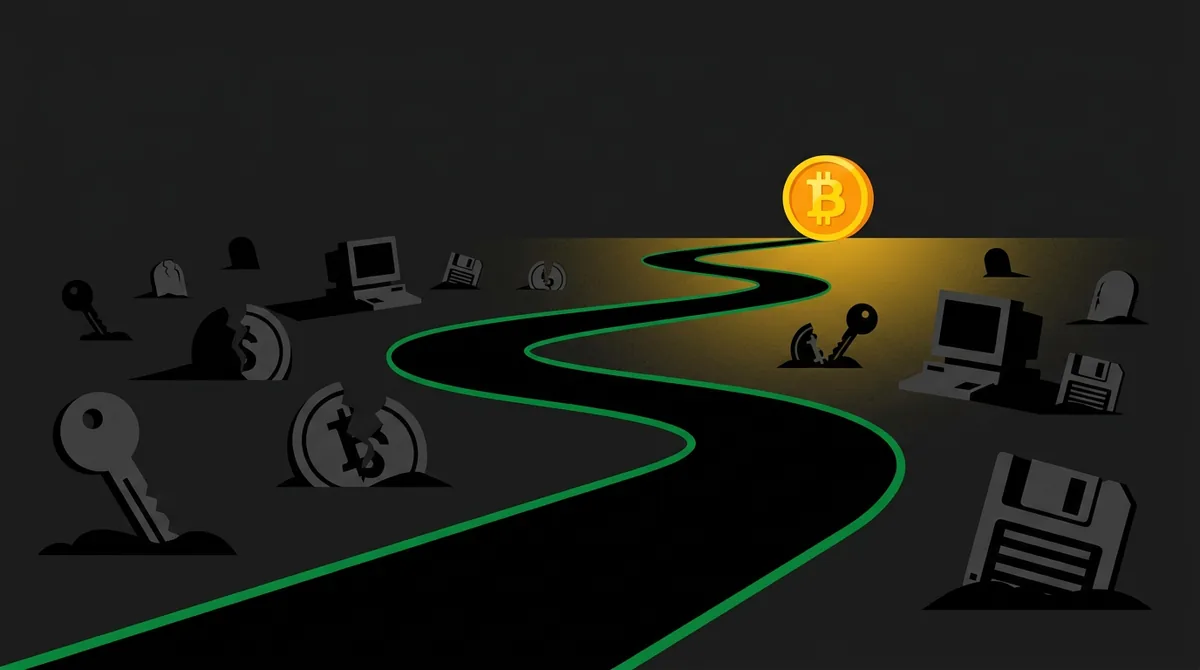
Before Bitcoin: Di Thirty-Year Hunt fi Digital Cash
When Satoshi Nakamoto posted the Bitcoin paper on Halloween night 2008, it looked like magic falling out of the sky. Nine pages, no company behind it, no bank, no boss. Plenty people still believe it really did come from nowhere.
It never come from nowhere. It was the last leg of a relay race that started decades before, with mathematicians and activists passing a baton that kept falling. Every runner before Satoshi solved one piece of the puzzle and died on the piece dem never solve. A Bitcoin history series making the rounds right now tells it as a relay race, and that is exactly weh it was.
Walk the graveyard with me. Because when yuh see all the dead experiments, every strange rule in Bitcoin stop being strange. Each one is a scar.
Di problem: money that copies
Start with the basic disease. A song file on yuh computer can be copied a million times and every copy is just as good as the original. That is the glory of digital things. But money is the one digital thing that cannot work like that. If I pay yuh with a file and then pay somebody else with the same file, one of us get robbed. The experts call it the double spend problem, and for thirty years it was the wall everybody hit.
1985: David Chaum and di blind signature
The first man to run a serious leg was a cryptographer named David Chaum. In the early eighties he invented something called blind signatures. Picture going to the bank to withdraw cash, but yuh hand the teller the request inside a sealed envelope. The bank signs the envelope without ever seeing inside. The signature proves the cash is real, but the bank has no idea which cash ended up with who. Real money, spending it online, and nobody tracking yuh.
In 1985 Chaum published the paper with a title that reads like a war cry today: transaction systems to make big brother obsolete. He saw something most of the world missed for another twenty years: if payment systems went digital and one company or government could watch every transaction, privacy would not slowly fade, it would be gone in a single upgrade.
Chaum's system, eCash, solved privacy. What it never solved was the middleman. The bank still had to sign every envelope, so the bank still had to be trusted, and the whole thing still had a company behind it. Chaum founded DigiCash in 1989 to commercialize it, and by every account the technology was beautiful. In 1995 Mark Twain Bank in St. Louis became the first bank in America to offer eCash to regular customers. The trial ended with roughly five thousand customers and about three hundred merchants. A much bigger licensing deal with Microsoft collapsed before it closed, and in 1998 DigiCash went bankrupt.
First lesson carved in the headstone: when the money lives inside a company, the money dies with the company. Anybody weh remember FINSAC, when di bank itself start wobble and whole heap of people money wobble with it, already know this lesson from the yard side. A payment system with a head office is only as immortal as the head office.
1993: Di cypherpunks and di manifesto
After DigiCash died, the baton passed to a strange culture, not a company. In the early nineties a group of cryptographers, engineers and general fringe characters in the Bay Area started meeting physically and arguing on a mailing list. Dem called themselves cypherpunks. In March 1993 one of the founders, Eric Hughes, published A Cypherpunk's Manifesto. Two lines from it still get quoted every single day in this space:
"Cypherpunks write code."
"Privacy is necessary for an open society in the electronic age."
Read that second one slowly and check the date. 1993. Before most people had email. This was a movement that understood where the world was heading: privacy would have to be defended with mathematics, not with promises, because systems that depend on people behaving well eventually meet people who don't.
DigiCash was a corporation trying to sell privacy. The cypherpunks were a culture building it in public, for free, as a way of life. That culture is the water Bitcoin eventually swam out of. The mailing list Satoshi posted to in 2008 was the direct descendant of this one.
1991: Stamping time itself
The next leg of the relay was not even about money. In 1991 two researchers, Stuart Haber and Scott Stornetta, published a paper on a deceptively simple problem: how do you prove that a digital document existed on a certain date and was never changed after, without trusting anybody's word for it?
Their answer was to link records together with cryptographic hashes, where each new record seals the previous one into itself. Tamper with anything in the middle and every seal after it breaks. Their company, Surety, went one step further: every week since 1995 they have published the latest hash in a classified ad in the New York Times, because a printed newspaper cannot be retroactively edited. It is the oldest running chain of hashes in the world, hiding in plain sight in the back of the paper of record.
When Satoshi's white paper lists its references, Haber and Stornetta's work is cited three times. The skeleton of how Bitcoin orders and seals its history came straight from this leg of the race.
1997: Adam Back and di postage stamp
The next runner solved a different problem entirely, and it turned out to be the motor everything needed. In March 1997, a young British cryptographer named Adam Back posted to the cypherpunk mailing list announcing something he called hashcash, a partial hash collision based postage scheme. The idea: to send you an email, my computer has to burn real computational work to produce a little proof, like licking a digital stamp. The stamp is hard to make and trivially easy to verify, so spamming a million people suddenly costs a million stamps of real electricity.
That property, work that is expensive to produce and instant to check, is exactly what money needs if it is not backed by any government. Physical gold gets its scarcity from the cost of pulling it out of the ground. Hashcash showed how to create digital scarcity from the cost of computation.
1998: Two blueprint, one missing piece
1998 was the year two people wrote down nearly complete blueprints for what Bitcoin would become, and neither one could build it.
Wei Dai, a brilliant young computer scientist, published a proposal he called b-money: money with no government in the loop at all, where participants keep each other honest. Dai was honest about the wall he hit: his design needed a broadcast channel everybody could trust, and he could not figure out how to get that without reintroducing the very middleman he was trying to remove.
The same year, Nick Szabo, a lawyer-minded cryptographer with a gift for naming things, designed bit gold: chains of hashcash-style puzzles, each solved proof becoming a scarce unit. Real work creating real scarcity, money born from cost, nobody's permission needed. Szabo was candid about his own gap: the system still needed a way to value and settle different chains of proof, and a trusted registry of identities, which put trust right back in the middle. He wrote that a generation later people would be amazed these ideas were not tried sooner, but ideas, as he knew, are not money. Both proposals stayed thought experiments on paper.
2004: Hal Finney and di server that trusted itself
The last man to run a leg before Satoshi was Hal Finney, a cypherpunk from the original mailing list and, by every account, one of the genuinely good souls in this whole story. In August 2004 Finney built and launched RPoW, reusable proofs of work. For the first time, hashcash proofs could actually be traded from person to person and passed along again, instead of being used once and discarded like a stamp. Real digital tokens, scarce by construction, transferable.
Finney engineered the trust problem as well as it could be engineered at the time: the system ran on an IBM 4758 secure coprocessor, a tamper-resistant piece of hardware whose internal state was published in hash form so anyone could verify the server never cheated. It was the best possible version of a bad architecture. It was still one server. If Hal's machine died, the money died with it, and everybody knew it. We met Hal already in this series: when the first Bitcoin transaction ever moved, ten coins, January 2009, it moved to him. The last runner handed the baton straight to the finisher.
2008: Di crash, and di nine pages
Now set the scene for the final handoff. On September 15 2008, Lehman Brothers filed for bankruptcy with 639 billion dollars in assets against 613 billion in debts, the largest bankruptcy in American history. The global financial system went into cardiac arrest, governments started bailing out the same institutions that caused it, and public trust in banks sank to generational lows. Anybody proposing an alternative to banks had just been handed the moment of a lifetime.
Six weeks later, October 31 2008, on the cryptography mailing list descended from the cypherpunk list, a message appeared from a name nobody knew:
"I've been working on a new electronic cash system that's fully peer-to-peer, with no trusted third party."
And here is the part that proves the relay race. Weeks before that post, Satoshi had quietly emailed Adam Back, the hashcash inventor, about the design. Back pointed him toward b-money. The very next day, August 22 2008, Satoshi emailed Wei Dai, and the published white paper cites Dai's work directly. In January 2009, after the software shipped, Satoshi wrote back to Dai: "I just released the full implementation of the paper I sent you a few months ago, Bitcoin v0.1."
So no, it never come from nowhere. Chaum asked the question and showed why privacy had to be built in from the start. Haber and Stornetta supplied the sealed, ordered history. Merkle's tree data structure packed thousands of transactions under one root hash. Back supplied the priced work. Dai and Szabo supplied the vision of scarce money with no government. Finney proved the tokens could actually move between people. What every single one of them was missing was the same thing: a way for strangers to agree on one shared history with nobody in charge of the agreement. That was the piece Satoshi actually solved, and it is the piece the white paper spends most of its nine pages on.
Every rule is a scar
Once yuh know the graveyard, Bitcoin's design stops looking weird and starts looking like memory.
No company behind it, no foundation that can go bankrupt like DigiCash. No central server whose death kills the money, the exact thing that doomed RPoW. No pre-mined pile for a boss to sit on top of, the pattern yuh already read about in every coin that came after. Mining that burns real work, straight from hashcash and bit gold, because money that costs nothing to create is worth exactly that. A public history sealed with hashes in strict order, straight from the timestamping work of 1991. Privacy techniques that treat anonymity as engineering, not a promise, straight from Chaum's warning.
Every dead experiment left behind exactly the lesson that got incorporated.
Di yard side of it
Now bring it home, because this history is not just ancient foreign news. Jamaica has been running its own experiment in digital money: Jam-Dex, the central bank digital dollar. The Bank of Jamaica minted JMD 257 million of it by mid-2021 and pushed hard, even offering JMD 2,500 to the first hundred thousand citizens who opened wallets. By the end of 2023, roughly 260,000 people had onboarded in a country of under three million, merchant adoption stayed thin, and the central bank governor left office publicly frustrated by how slowly the country took to it.
Ask why, and part of the answer runs straight back to 1985. Jam-Dex is digital cash where one party can see everything: every transaction, every balance, every pattern. That is precisely the big brother system Chaum was warning the world about, and Jamaicans, who handle cash heavily and keep their business their business, have been quietly declining to opt in. Low uptake is not a marketing failure. It might be the most rational thing on the island.
The cypherpunks' answer to the same question was the opposite branch of the tree: a digital dollar where nobody has to be trusted, because nobody can be. Yuh hold yuh own keys, yuh money live in math that thirty years of dead ends taught the world to build, and no head office anywhere can wobble it.
Thirty years of almost. Nine pages of finally. We already walked those nine pages themselves, section by section, in a previous piece. And the next time somebody tell yuh Bitcoin come outta nowhere, tell dem the truth: it come outta everywhere.